
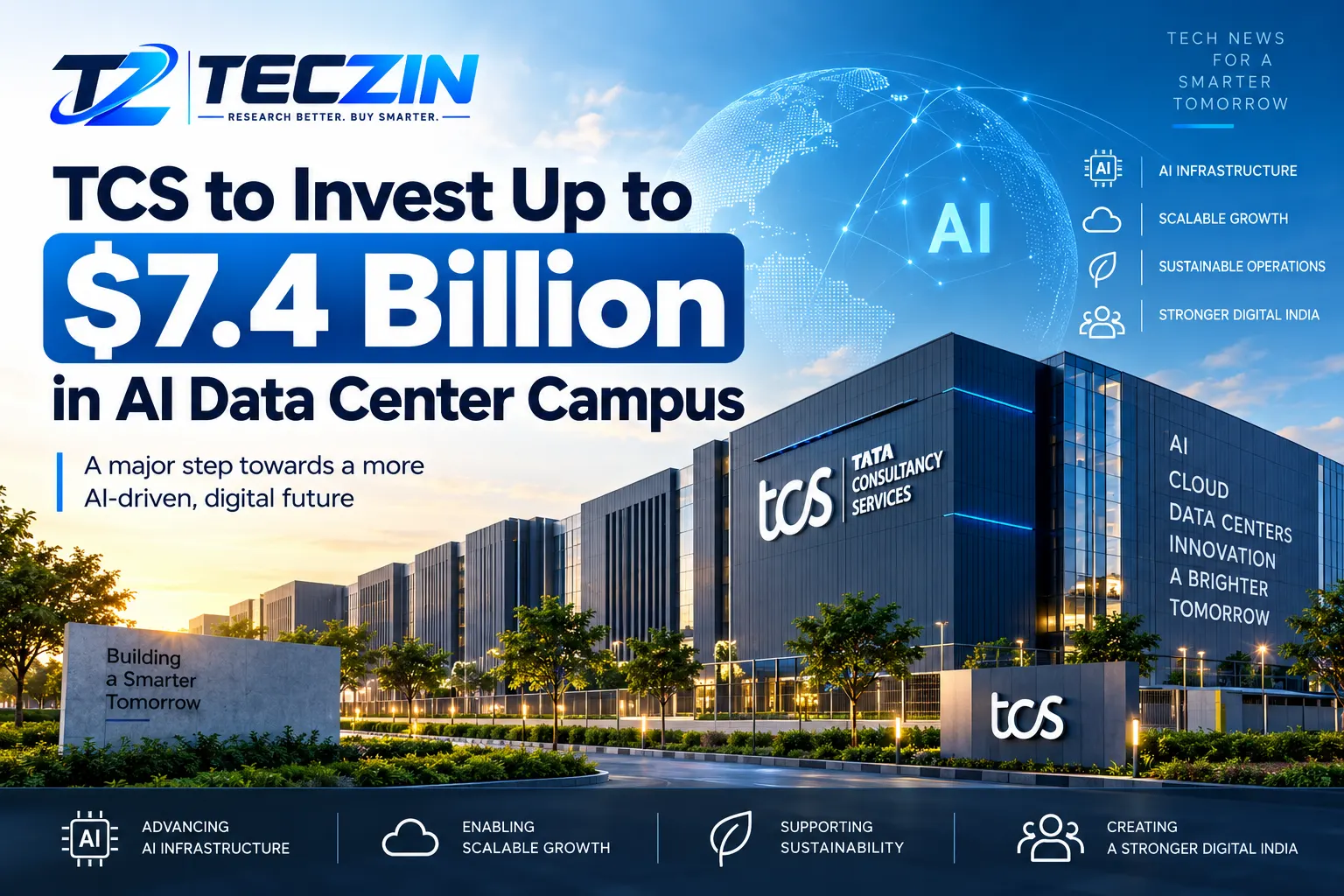
A unit associated with TCS is reportedly preparing to invest up to $7.4 billion in an artificial intelligence-focused data center campus, according to the report cited by TecZin. The proposed investment would place the project among the larger planned commitments connected with AI computing infrastructure.
At this stage, the headline provides only a limited outline of the proposal. It identifies the investor as a TCS unit, describes the development as an AI data center campus and puts the maximum potential investment at $7.4 billion. The report does not, in the supplied information, confirm the campus location, construction schedule, computing capacity, energy requirements, financing structure or the identity of any technology partners.
Important: The investment and project details should be treated as reported or unconfirmed until TCS, the relevant unit or an authorised public body formally announces them.
What the reported investment could mean
AI systems require substantially more computing resources than many conventional business applications. Training and operating advanced models can involve large clusters of specialised processors, high-speed networking, extensive storage and cooling systems capable of supporting sustained workloads. A dedicated campus could be designed to bring several of those elements together at a single site.
However, the phrase “AI data center campus” does not, by itself, establish the precise nature of the planned facility. It could refer to one large site, a group of connected facilities or a broader infrastructure programme. It also does not confirm whether the campus would be operated exclusively for TCS, made available to customers or used through partnerships with cloud and semiconductor companies.
The “up to” wording is also significant. It indicates a maximum potential commitment rather than a guaranteed amount that will necessarily be spent immediately. Large infrastructure projects are often developed in phases, with final spending dependent on approvals, demand, financing, construction progress and technical requirements. No breakdown of the proposed $7.4 billion figure was provided in the supplied feed metadata.
Why AI infrastructure is attracting major investment
The growth of generative AI has increased demand for data centers capable of handling large-scale model training, inference and data processing. These facilities need more than conventional server rooms. They may require specialised accelerator hardware, high-bandwidth interconnects, advanced cooling, resilient power systems and network links designed for large volumes of data.
For technology services companies, control over infrastructure can potentially support several business goals. It may help them offer AI development and deployment services, provide computing capacity to enterprise customers and build more predictable operating arrangements for high-demand workloads. It could also reduce reliance on externally available capacity when demand for AI-related services rises.
Those are industry-level considerations, not confirmed objectives for the reported project. The supplied information does not state how TCS intends to use the proposed campus or whether the facility would support internal operations, customer services, third-party workloads or a combination of these activities.
Key details that remain unanswered
Several important questions remain open because the supplied report summary contains no additional project information:
- Location: The proposed site or sites have not been identified in the available metadata.
- Timeline: There is no confirmed start date for construction or expected operational date.
- Capacity: The number of data centers, servers, AI accelerators or other computing units has not been disclosed.
- Funding: The structure of the proposed investment, including debt, equity or customer-backed financing, is unknown.
- Power and cooling: No information has been supplied about electricity demand, water use, cooling technology or renewable-energy arrangements.
- Ownership and operation: It is not clear which TCS unit would lead the project or whether outside partners would be involved.
- Regulatory status: The available information does not confirm whether the project has received planning, environmental or other approvals.
Potential impact on the data center market
If confirmed and completed at the reported scale, the project could become a significant addition to the AI infrastructure market. A multi-billion-dollar commitment would signal that demand for AI computing is influencing investment decisions beyond traditional cloud providers and hardware companies.
Such a development could also increase competition for high-capacity electricity connections, suitable land, networking infrastructure and specialised engineering talent. These factors are central to the delivery of AI facilities, but the supplied information does not indicate whether the proposed campus has secured any of them.
The effect on customers would depend on the campus’s eventual business model. A facility built to serve enterprise workloads could support AI application development, analytics and model deployment. A site intended mainly for internal use would have a different commercial impact. Until TCS or the relevant unit publishes more information, it is not possible to determine which model is being considered.
Why the investment figure needs context
A headline investment figure can cover several categories of spending. In a data center project, the total may include land, buildings, electrical infrastructure, cooling, networking, security, computing equipment and later expansion. It may also represent a long-term programme rather than a single construction phase.
For that reason, the reported $7.4 billion figure should not be interpreted as the cost of a completed facility or as an immediate cash outlay. The word “up to” leaves room for the final amount to be lower, and no schedule has been provided for when the investment might occur.
Readers should also distinguish between a proposed investment and a commissioned data center. A proposal can change substantially before construction begins. It may be revised because of market conditions, technology changes, supply constraints, regulatory requirements or shifts in customer demand.
What to watch for next
The next meaningful update would be an official statement from TCS or the named unit. Such an announcement could clarify the project’s location, ownership, investment schedule and intended workloads. Additional information from planning authorities, energy providers or business partners could also help establish the project’s status.
Technical disclosures would be especially important. Details about processor suppliers, power capacity, cooling design, networking architecture and data sovereignty would show whether the campus is intended for large-scale model training, AI inference, conventional cloud services or a mixture of workloads.
Until those details are available, the most accurate description is that a TCS unit has been reported as planning a potential investment of up to $7.4 billion in an AI data center campus. The project’s final scope, timing and commercial purpose remain unconfirmed.
FAQs
What is TCS reportedly investing in?
A TCS unit is reportedly planning to invest up to $7.4 billion in an AI-focused data center campus. The supplied information does not identify the specific unit or provide a detailed spending plan.
Has the $7.4 billion investment been officially confirmed?
Not in the information supplied for this article. The figure should be treated as a reported maximum commitment until TCS, its relevant unit or an authorised source confirms the project.
Where will the AI data center campus be built?
The location has not been provided in the supplied feed metadata. No site should be treated as confirmed without an official announcement.
When will the campus become operational?
No construction or operational timeline is available from the supplied information.
Why would a company build an AI data center campus?
AI workloads can require specialised computing, networking, storage, power and cooling. A dedicated campus could provide infrastructure for internal workloads or customer services, but TCS has not, in the supplied information, confirmed the intended use of the proposed facility.