

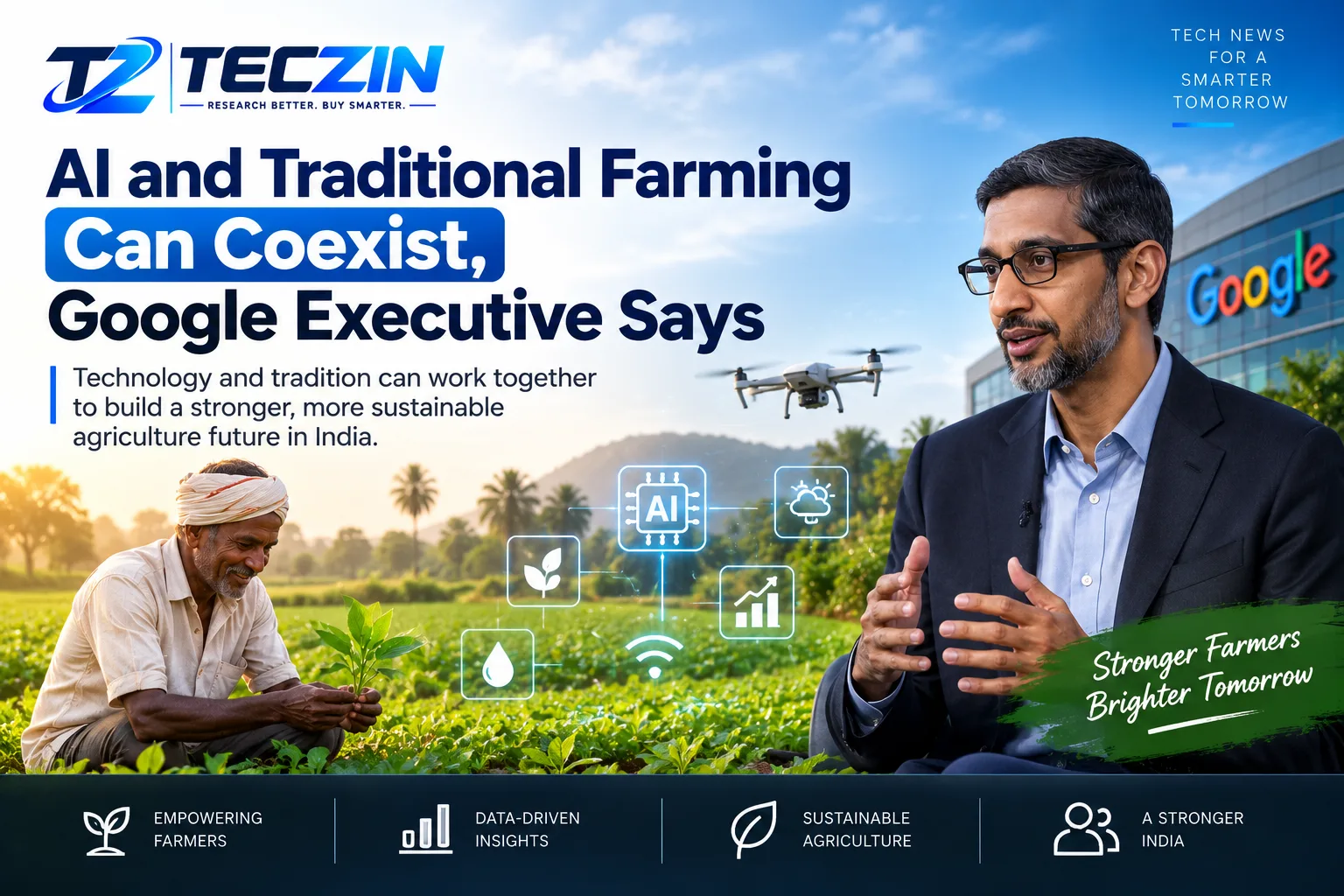
Artificial intelligence and traditional farming practices do not have to be competing approaches, according to a Google executive cited in a report by The Indian Express. The discussion focused on the need for agricultural AI models that reflect India’s diverse farming conditions rather than treating technology as a substitute for local knowledge.
The central message, as presented in the supplied report headline, is that AI can work alongside established agricultural practices. That distinction matters in a sector where decisions are shaped by local soil, weather, crops, water availability and generations of farmer experience.
The report does not, in the supplied feed metadata, provide detailed information about a specific product, model, pilot programme or deployment. Those details should therefore not be treated as confirmed here. What is clear from the headline is the broader position attributed to the Google executive: agricultural AI developed for India should be compatible with traditional farming models.
Why coexistence is important
Technology discussions often frame AI as a tool that will automate or replace existing processes. Farming is more complicated. Agricultural decisions are rarely based on one data point, and local experience can influence how farmers respond to changing conditions.
A farmer may combine observations about a field with knowledge passed through a community. An AI system, meanwhile, may process large volumes of information and identify patterns that are difficult to detect manually. A practical agricultural model could bring those two forms of knowledge together instead of assuming that one must displace the other.
This is particularly relevant in India, where agricultural conditions vary significantly between regions. A model designed around a narrow set of assumptions may not perform equally well across different crops, climates, languages or farming methods. The Google executive’s reported comments point towards the importance of building models with local realities in mind.
What an India-focused agricultural model may need to account for
The supplied headline refers to “Indian agri models”, but it does not identify a particular model or list its technical features. In general terms, however, an agricultural AI system intended for India would need to address several practical issues.
| Consideration | Why it matters |
|---|---|
| Local conditions | Recommendations may need to reflect regional differences in climate, soil, crops and water access. |
| Language and accessibility | Tools are more useful when farmers can interact with them in familiar languages and formats. |
| Traditional knowledge | Local experience can provide context that is not always captured in formal datasets. |
| Reliability | Incorrect advice can have financial consequences, making testing and transparency essential. |
| Connectivity and cost | Solutions must account for the devices, networks and budgets available to intended users. |
These points are editorial analysis rather than details confirmed by the supplied report metadata. They illustrate the practical questions that arise when AI is applied to farming.
AI should support decisions, not remove human judgement
The reported position also raises a broader question about how agricultural technology should be designed. A system that presents itself as an unquestionable authority may be less useful than one that gives farmers information they can evaluate alongside their own observations.
That could mean presenting forecasts, identifying potential risks or helping users compare options, while leaving the final decision with the farmer. Such an approach recognises that AI outputs can be incomplete or wrong, especially when the data used to train or operate a model does not represent every region and farming practice.
The wording attributed to the Google executive should not be read as confirmation that a specific Google agricultural service is being launched. The supplied information does not announce a product, release date, partnership or commercial availability. Any claims about those matters remain unconfirmed based on the available feed metadata.
The data challenge behind agricultural AI
AI models depend on data, but agricultural data can be difficult to collect and interpret. Information about crop conditions, weather, irrigation, pests and yields may be recorded in different ways or may not be available consistently across regions.
Even a large dataset may not fully capture the experience of farmers who work in conditions that are underrepresented in the data. This is one reason that collaboration with farming communities can be important when models are designed and evaluated.
There is also a difference between generating a prediction and making it useful. A recommendation must be understandable, timely and relevant to the resources available to the person receiving it. If a model identifies a risk but offers no realistic response, its practical value may be limited.
Unconfirmed claims and what the report does not establish
- Confirmed by the supplied feed: The source headline attributes the view that AI and traditional farming can coexist to a Google executive and connects the discussion with Indian agricultural models.
- Not confirmed by the supplied feed: The identity of the executive, the name of any AI model, the organisations involved, the location of any project and the scale of any deployment.
- Not confirmed by the supplied feed: Claims about measurable benefits, farmer adoption, crop yields, cost savings or commercial availability.
Readers should consult the original report for the full context, including the executive’s identity and the specific remarks made during the discussion.
Why the approach could matter beyond farming
The reported argument reflects a wider principle for AI development: systems are more likely to be adopted when they fit existing practices instead of demanding that users completely change how they work. In agriculture, this may be especially important because farming decisions are closely tied to local conditions and livelihoods.
It also suggests that success should not be measured only by the sophistication of a model. Usability, trust, local relevance and the ability to explain recommendations may be equally important. These considerations could shape how companies, researchers and public institutions evaluate agricultural AI initiatives in India.
For now, the available information supports a broad conclusion rather than a product announcement. Google’s reported position is that AI and traditional farming can coexist, and that Indian agricultural models should be developed with the country’s existing farming context in mind. The practical impact of that approach will depend on the models, data, partnerships and deployments that may follow.
Frequently asked questions
What did the Google executive reportedly say?
The supplied headline says the executive argued that AI and traditional farming can coexist. The feed metadata does not include the full quotation or additional remarks.
Is Google launching a farming AI product?
There is no product launch, release date or commercial service identified in the supplied information. Any claim that a specific Google farming product is being launched is unconfirmed here.
Why do agricultural AI models need local data?
Farming conditions differ between regions, including crop choices, weather, soil, water access and farming practices. Local data can help models produce advice that is more relevant to the communities using them.
Will AI replace traditional farming knowledge?
The position attributed to the Google executive is the opposite: AI and traditional farming can work together. In practice, the balance would depend on how a system is designed and how farmers use its recommendations.
Where can readers find the original report?
The source supplied for this article is The Indian Express.